“The leaders who will thrive aren't the ones who know the most about AI. They're the ones who can still make good decisions when nobody knows enough.”
In boardrooms, AI has acquired the aura of inevitability. Few senior executives now doubt that it will reshape their organisations. Yet the more sober question is whether their organisations can reshape themselves fast enough to capture the value.
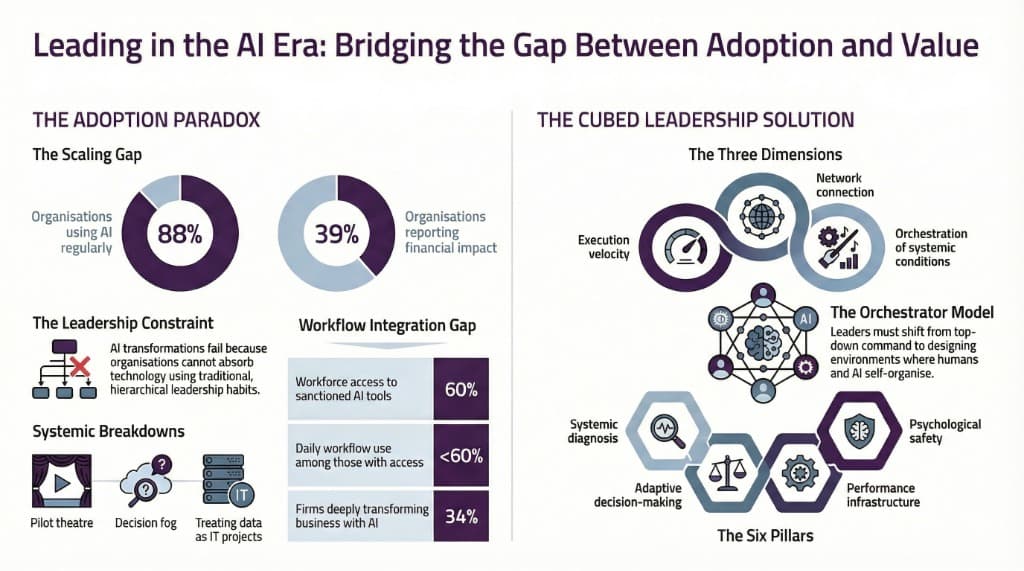
The early evidence is awkward. AI usage is high, but enterprise impact remains stubbornly limited. McKinsey reports 88% of organisations are using AI regularly in at least one function, but only around one-third say they are scaling AI across the enterprise, and just 39% report any enterprise-level EBIT impact. A newly published NBER working paper, drawing on nearly 6,000 senior executives across the US, UK, Germany and Australia, finds around 70% of firms actively use AI, but more than 80% report no effect on productivity or employment over the last three years; senior leaders' own use averages about 1.5 hours a week. Deloitte's latest global survey finds worker access to sanctioned AI tools has widened sharply, but fewer than 60% of those with access use it in their daily workflow, and 84% of firms have not redesigned jobs or the nature of work around AI capabilities.
This gap between access and activation is not, in the main, a technology gap. It is a leadership gap. This paper explains why AI transformations fail, why the failure is usually human rather than technical, and what leaders must change to make transformation succeed at scale.
The adoption paradox: AI everywhere, outcomes elusive
The easiest way to misunderstand the moment is to believe that “adoption” is the finish line. Adoption is merely the ability to access a tool. Transformation is the ability to produce different outcomes reliably, at scale, under real constraints.
On the adoption side, the numbers look impressive. McKinsey's global survey points to pervasive regular use. Deloitte reports that workforce access to sanctioned tools has expanded by 50% in a year, rising from under 40% to around 60% of workers. Organisations are, in other words, buying picks and shovels.
On the outcomes side, the story is less triumphant. The NBER evidence suggests most firms are not yet seeing productivity or employment effects. McKinsey's respondents report use-case benefits and innovation, but enterprise-level financial impact is still limited. Deloitte finds only 34% are “deeply transforming” the business with AI, while 37% are using it at a surface level with little or no change to underlying processes.

It is tempting, when faced with this, to blame execution and call for more project management, more training, more platform consolidation. That reflex is understandable, and usually wrong.
AI is not failing because teams cannot build. It is failing because organisations cannot absorb. The constraint is not model capability; it is organisational capability. That is why the rhetoric lands: “AI isn't waiting for your strategy cycle.” AI shrinks the distance between intention and execution, and it does so in a way that exposes the weaknesses of the leadership system itself.
To put it plainly: many organisations are attempting to run a high-velocity, high-ambiguity, high-delegation operating environment with leadership habits built for predictability, hierarchy, and control.
Why transformation failure is the default, and why AI makes it worse
Before blaming AI, it helps to remember that most large transformations fail even when the technology is familiar. BCG found 70% of digital transformations fall short of their objectives. McKinsey has repeatedly reported that transformation success rates hover around 30%, a figure that “hasn't budged” despite years of effort.
AI does not invent these failure dynamics. It accelerates them.
Digital transformation already strains organisations because it forces changes in processes, roles, power, and culture, which are always political and rarely neat. AI adds three complications.
First, it compresses time. Decisions that once took weeks now get forced into days because the technical cycle is shorter and competitive pressure is higher. Second, it decentralises authority. When a team can access powerful tools directly, traditional approval chains become bypassable, and often are. Third, it reduces legibility. AI outputs are probabilistic, the causal chain is less visible, and responsibility becomes easier to evade.
Leaders collapse into command or stall in coordination, neither of which holds under AI conditions.
Deloitte's own language is similar in spirit: organisations are at an “untapped edge”, struggling to move from ambition to activation, with governance and operating model redesign emerging as the real constraints.
So the question is not “why are AI programmes hard?” The question is “what human system is AI exposing as inadequate?”
The real reasons most AI transformations fail
In most organisations, failure is not dramatic. It is quiet. It looks like a portfolio of pilots, a stream of demos, scattered pockets of enthusiastic use, and a stubborn lack of enterprise-level outcomes. People are busy, yet progress feels thin. Executives then reach for the familiar remedy: more communications, more training, more tooling.
The pattern is now explicitly documented. Harvard Business Review describes the stall: employees experiment with tools but do not integrate them deeply into how work actually gets done, leaving leaders worried about returns. Deloitte provides the quantitative cousin of that observation: access rises, but daily workflow use remains under 60% among those with access. This is not “resistance to change” in the abstract. It is a rational response to an operating environment that has not been redesigned to make new behaviour the path of least resistance.
The failure mechanisms are consistent across sectors. They can be summarised as five system-level breakdowns.
1) Pilot theatre replaces workflow change
A pilot is politically cheap. It creates visible motion without forcing hard trade-offs. It is also, in many organisations, a way to postpone the messy work of redesigning how decisions are made and how people work.
Gartner's forecast that at least 30% of generative AI projects would be abandoned after proof of concept by the end of 2025 is a useful reality check. The reasons Gartner cites are telling: poor data quality, inadequate risk controls, escalating costs, or unclear business value. In other words, initiatives fail when they meet the real world.
Pilots succeed by avoiding the world. Scale demands that you enter it.
2) Decision fog creates paralysis or shadow AI
AI changes the decision landscape: what can be automated, what must remain human judgement, where accountability sits when systems act semi-autonomously, and how errors are detected and handled.
Most firms do not answer those questions explicitly. They end up with decision fog. Sometimes everything gets escalated to committees, slowing delivery until teams route around governance. Sometimes everything is devolved to local teams, producing inconsistent behaviour, hidden risk, and inevitable political backlash when something goes wrong.
This is why “agentic AI” is both promising and dangerous. Deloitte finds that nearly three in four companies plan to deploy agentic AI within two years, yet only 21% report a mature governance model for autonomous agents. When oversight lags behind autonomy, organisations are not innovating, they are gambling.
3) Data readiness is treated as an IT problem, not an organisational discipline
AI needs data that is reliable, governed, and observable. Most organisations have data that is fragmented, inconsistently owned, and politically contested. So AI programmes discover a truth many leaders prefer to avoid: data quality is not a technical nuisance, it is a management failure.
Gartner predicts that through 2026 organisations will abandon 60% of AI projects unsupported by AI-ready data. This is not an abstract warning. It is a diagnosis of how often firms attempt to build advanced capability on unstable foundations.
The deeper point is that “data readiness” requires an operating model: ownership, standards, incentives, and ongoing investment. You cannot outsource that to a platform team and call it done.
4) Trust erodes, and with it the organisation's capacity to learn
AI integration changes team dynamics. It shifts what competence looks like, who is trusted, and how people coordinate work. Leaders often focus on efficiency and automation, while missing the interpersonal consequences: declining trust, coordination issues, and second-guessing.
Harvard Business Review explicitly warns that integrating AI can degrade interpersonal trust and decision-making, and argues adoption should be treated as team development, not a tech upgrade, by focusing on psychological safety.
This matters because scaling AI is a learning process. Without psychological safety, people stop reporting edge cases, stop admitting uncertainty, and stop sharing workarounds. The organisation's feedback loops break. Models do not improve in the ways that matter. The transformation becomes brittle.
Evolve Cubed's conviction that transformation at pace depends on trust, and that programmes must begin with the conditions for psychological safety, is not a soft preference. It is an operational requirement.
5) Governance arrives late, then blocks everything
Many organisations bolt governance on after the exciting work has begun. This turns governance into friction, and friction into an excuse. Teams then see responsible AI as “what stops us shipping”, and risk teams see delivery as “what creates risk”. Both sides become correct, and both sides become enemies.
The more mature view is that governance is not the brake. It is the steering.
PwC's 2025 Responsible AI survey frames this well: responsible AI is a “team sport” that requires clear roles and tight hand-offs, using a three lines of defence model designed for both speed and trust. Gartner's February 2026 commentary is even blunter about where this is heading: global regulation is turning AI governance platforms from a nice-to-have into a necessity.
In other words, governance is not optional. The only question is whether it will be designed to enable speed, or improvised in crisis after a failure.
What leaders actually need to change: from running people to designing systems

Most leadership training still assumes a world where expertise is scarce and information is expensive. In that world, leaders win by being right, deciding fast, and driving execution through hierarchy.
AI flips the economics. Answers become cheap. Expertise becomes more distributed. What becomes scarce is not intelligence, but judgement, integration, and the ability to coordinate a complex system at speed.
This is where the framing becomes both useful and, frankly, unavoidable. AI pressure reveals three leadership modes.
The first is the Driver: execution, direction, velocity. The second is the Connector: coordination, collaboration, information flow. Under AI conditions, leaders who remain Drivers often tighten control and centralise decisions, which slows adaptation and encourages shadow AI. Leaders who remain Connectors often drown in alignment, creating process without momentum.
The third mode is the one most organisations lack: the Orchestrator, who designs the conditions in which humans, processes and AI can self-organise inside clear guardrails. This is not abdication. It is institutional design. It is the shift from “I decide” to “I design how decisions get made, who owns them, and how the system learns”.
Leaders must stop asking, “How do we deploy AI?” and start asking, “What human system must we redesign so AI can be used safely, consistently, and profitably at scale?”
Deloitte's research points to the same conclusion from a different angle: many organisations are focused on AI fluency, but have not redesigned work, roles, or processes around AI capabilities, which leaves value trapped at the surface.
The six capabilities that separate scaled transformation from stalled adoption
Evolve Cubed's “Six Pillars of Evolved Leadership” provides a practical taxonomy for the leadership capabilities that matter under AI acceleration. The value of the framework is not that it names virtues; it describes the behaviours that allow organisations to move from pilots to durable outcomes.
What follows is those six capabilities translated into the language of execution.
Leadership reframing: authority shifts from expertise to judgement
When machines can draft, analyse, summarise and propose, leaders lose the ability to rely on expertise as their main source of authority. Many respond by overcompensating: becoming more performative, more certain, and more controlling.
That is a mistake. AI does not reward certainty. It rewards clarity about trade-offs.
Leadership reframing is the move from being the smartest person in the room to being the person who can state what matters, define acceptable risk, and make decisions when information is incomplete. It is also the willingness to be accountable for those decisions, rather than hiding behind a model, a committee, or a consultant.
Systemic diagnosis: seeing the organisation as a living system
Most AI roadmaps are built around use cases. The stronger approach begins with leverage points. Where do decisions slow down? Where do hand-offs fail? Where do incentives reward the wrong thing? Where is risk being silently accumulated? Where is customer experience degraded by internal fragmentation?
This matters because AI transformations fail when organisations treat symptoms with tools. They succeed when leaders change the system that creates the symptoms.
Adaptive decision-making: speed without recklessness, ethics without paralysis
AI raises the tempo. It also increases the number of decisions that must be made under uncertainty. This is where many leadership teams break: they either demand certainty and stall, or chase speed and create avoidable incidents.
Adaptive decision-making is a disciplined middle: structured protocols for deciding fast with imperfect information, while staying ethical and accountable. It includes designing decision rights and escalation paths for human and AI agents, and making those rules explicit so teams can move without constant executive intervention.
Trust at speed: psychological safety as performance infrastructure
AI adoption is often framed as a skills issue. In reality, it is just as often an identity issue. People fear becoming irrelevant. Managers fear losing authority. Experts fear being exposed. In that climate, learning slows.
Trust at speed is the capability to maintain confidence, transparency and psychological safety as change accelerates. HBR's warning about trust erosion is useful because it makes the cost explicit: if trust declines, coordination suffers, decision-making degrades, and performance falls even if the tools improve.
This is where the Daniel Pink lens becomes practical. Adoption rises when people experience autonomy, mastery and purpose in the new system. It collapses when AI is experienced as surveillance, deskilling, or a quiet redundancy plan. Leaders who ignore this are not being tough-minded. They are being naive about human motivation.
Influence without authority: mobilisation in a matrixed organisation
AI value rarely sits inside one function. It crosses operations, data, risk, legal, product and customer. That means formal authority is often insufficient.
Influence without authority is the capacity to mobilise action across boundaries through meaning, narrative and behavioural insight, particularly when hierarchy is no longer the main coordination tool. Deloitte's survey hints at why this matters: many organisations claim strategic readiness, but feel operationally unsure in infrastructure, data, risk and talent, precisely because these domains span organisational boundaries.
Strategic integration: making the change stick
Most organisations can create a burst of AI enthusiasm. Few can institutionalise it.
Strategic integration is the ability to lock in gains by embedding new behaviours into operating rhythm, decision forums and performance systems so progress does not fade when attention shifts.
This is the difference between AI as a programme and AI as a capability. The first is a budget line. The second is an organisational advantage.
A leader's blueprint for closing the gap between AI strategy and execution
It is easy to write a strategy. It is hard to build an operating model that can execute it. The blueprint below is not a theory of AI. It is a theory of scaled organisational change under AI conditions.
Start with decisions, not use cases
The unit of value is not the model. It is the decision.
Identify the few decisions that matter most to performance and risk. In a bank, that might be credit approval, fraud triage, customer retention offers. In a retailer, demand forecasting and price optimisation. In a hospital trust, staffing, referral prioritisation, discharge planning. Then ask, for each decision, what the role of AI should be: assist, recommend, act under defined constraints. Make accountability explicit. Make escalation rules explicit. Define what evidence must be logged.
This is what Evolve Cubed calls decision architecture: enabling humans and AI to self-organise into aligned execution inside guardrails. It is also the only way to stop decision fog.
Redesign workflows so AI use becomes normal, not optional
HBR's adoption stall diagnosis, that employees experiment but do not integrate tools into daily work, is a warning that “training” will not solve. People follow the workflow. If the workflow does not require AI, usage will remain sporadic.
Deloitte's data underlines the point: many companies are educating employees, but far fewer are rearchitecting roles, workflows and career paths. If you want value, you must redesign how work gets done, not merely give people access to new tools.
Build governance before scale, and build it for speed
Governance cannot be a late-stage compliance gate. If it is, teams will route around it and risk will become invisible.
PwC's three lines of defence framing is useful because it assigns clear roles: build and operate responsibly, review and govern, assure and audit. Deloitte reinforces the leadership point: governance is the difference between scaling successfully and stalling out, and value is greater when senior leadership actively shapes it rather than delegating it away.
A good governance design is risk-tiered. Low-risk applications move quickly. High-risk applications receive deeper review. Everything generates telemetry so the organisation can learn.
Treat data as a product, with ownership and standards
Gartner's AI-ready data warning should be read as an organisational red flag, not a technical footnote. If your data is not owned, measured, and improved like a product, AI will expose the weakness. Leaders need to make data quality and lineage a performance discipline, not an IT aspiration.
Deloitte's report puts this in modern terms: legacy architectures cannot power real-time, autonomous AI; organisations need a “living” technology and data infrastructure with domain-owned data products and enterprise standards for quality and lineage. That is not something that can be fixed by buying another tool. It requires operating model decisions.
Redesign incentives and status, or expect theatre
If you reward people for throughput in old processes, they will protect those processes. If you reward managers for headcount and control, they will resist decentralised capability. If you punish errors harshly, you will suppress the reporting that makes AI safe.
This is why trust at speed is a real leadership capability. It is also why AI transformations so often become performative. People do what is safe. They do not do what is risky and unrecognised.
Move from AI literacy to AI judgement
Senior leaders do not need to understand the mathematics of transformers. They need to understand the conditions under which AI outputs are reliable, the circumstances under which they fail, and the governance required to keep accountability human.
The executive programme language is pointed: leaders must be able to make defensible decisions at speed, govern trust and ethics without slowing the organisation, and mobilise the system when authority decentralises. That is precisely the competency gap many organisations face, and it is why AI becomes, at heart, a leadership development challenge.
Conclusion: AI will not transform your company. Your leadership system will.
AI is already being deployed widely. The world is not short of pilots. It is short of organisations that can turn pilots into repeatable outcomes.
The evidence is consistent across research houses and surveys. Adoption is high. Scaling is limited. Workflow redesign is rare. Executive use is shallow. Many firms are not yet seeing material productivity effects. Meanwhile, project abandonment remains common when initiatives collide with data quality, governance, cost, and unclear value. Regulation is tightening, making governance and auditability less optional by the quarter.
The organisations that pull ahead will not do so because they found a better model. They will do so because they redesigned the human operating model around the new reality: compressed time, decentralised authority, and opaque systems.
That redesign is leadership work. Not inspirational leadership. Structural leadership.
The winners will not be the organisations with more Drivers or better Connectors. They will be the ones that build Orchestrators: leaders who can create the conditions in which humans and AI self-organise into aligned execution, with trust, clarity and speed.
This paper draws on publicly available research from McKinsey, Deloitte, BCG, Gartner, PwC, Harvard Business Review, and the National Bureau of Economic Research. All citations link to source material. Published February 2026.