White Paper · Wellbeing & AI
The Human Constraint
Why psychological wellbeing becomes the decisive capability in the AI workplace
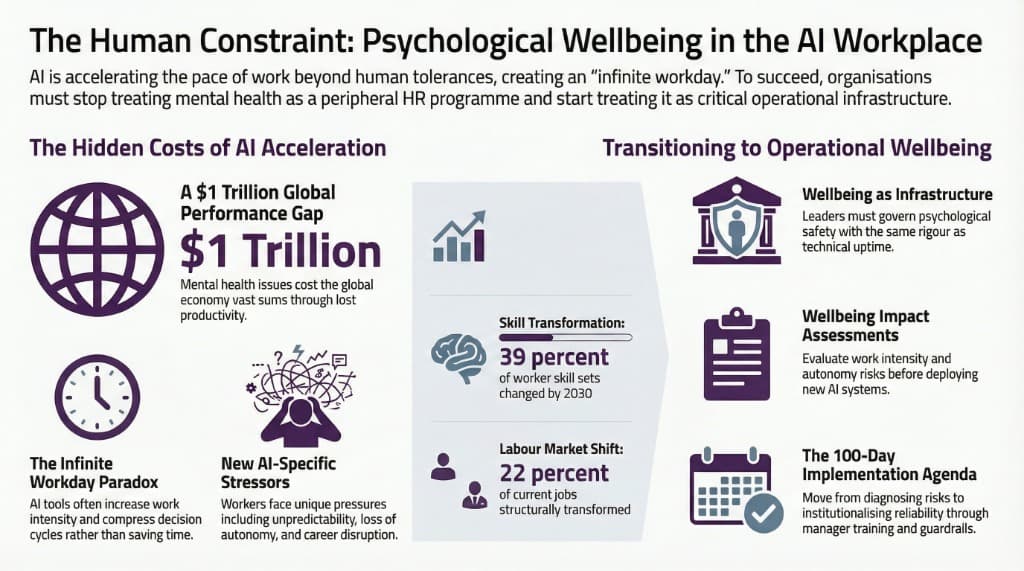
AI is moving faster than most organisations can metabolise. The next binding constraint is not compute, data, or models, but psychological wellbeing. Work is already emotionally expensive: Gallup's global data for 2025 shows 23% of employees experienced sadness and 22% experienced loneliness “a lot” of the previous day. The World Economic Forum expects 39% of workers' existing skill sets to be transformed over 2025–2030.
AI intensifies this through increased pace, compressed decision cycles, and inflated expectations. Leaders must treat psychological wellbeing as operational infrastructure, not an HR programme.
The inconvenient truth: mental health is already in the P&L
The workplace has always shaped mental health. What has changed is the intensity and visibility of the cost.
WHO and ILO material consistently frames mental health at work as an economic issue, not merely a personal one. Depression and anxiety are estimated to cost the global economy about US$1 trillion each year, predominantly through lost productivity. (WHO) The WHO guidelines on mental health at work also make the point that evidence-based interventions exist, including organisational measures and manager training, but they require deliberate implementation rather than goodwill.
Leaders often misread that as an HR responsibility. It is more accurate to treat it as a constraint on performance, quality, and risk. In the AI era, this constraint tightens.
The WEF Future of Jobs 2025 report sketches the scale of disruption. Over 2025–2030 it projects structural labour-market transformation amounting to 22% of today's jobs, with 170 million new jobs created and 92 million displaced, for net growth of 78 million. The same report positions “resilience, flexibility and agility” among the most sought-after core skills. This matters because resilience is not a poster slogan. It is an operating requirement.
There is a second signal: employers are starting to treat wellbeing as a talent supply lever. WEF reports that 64% of surveyed employers identify supporting employee health and wellbeing as a key strategy to increase talent availability. In other words, even the market is pricing this in.
The human system is under strain, and leaders are being forced to care, even if only for utilitarian reasons.
AI is not just changing tasks. It is changing the psychology of work
AI does not land in a calm workplace. It lands in a workplace already flooded with noise, interruptions, and coordination overhead.
Microsoft's analysis of the “infinite workday” is worth reading not because it is Microsoft, but because it is based on aggregated productivity signals at vast scale and it captures something leaders often deny: the working day has become porous. The average worker receives 117 emails daily, 153 Teams messages per weekday, and is interrupted on average every two minutes by meetings, emails, or notifications. After-hours activity is rising, including late-evening inbox returns and weekend email checking.
Now layer AI on top.
Most organisations deploy AI with a narrow ambition: automate work and reduce cost. The lived effect is broader: AI compresses cycles and raises the expected baseline. When the first draft arrives in seconds, the “real work” shifts to judgement, integration, and accountability. That can be more cognitively taxing than producing the draft in the first place. It is a transfer from effort to responsibility.
A study on AI and autonomy at work notes that three-quarters of AI users reported AI increased the pace of work, leading to increased work intensity. This is the dark joke of productivity tools. They reduce friction, then management reclaims the freed time, and the bar moves up.
The OECD's work on trust in AI adds another layer: anxiety and insecurity. It reports that three in five workers worry about losing their job to AI in the next ten years. Whether or not that worry is justified in any given job family, the psychological impact is real. Uncertainty is not neutral. It consumes attention.

From technostress to AI-stress
Traditional “technostress” research already identifies familiar stressors: overload, invasion into personal life, complexity, insecurity, and uncertainty. What changes with AI is the combination: AI systems can be opaque, autonomous, and embedded into management itself.
A 2025 systematic review proposes that AI amplifies the established technostressors and introduces five emerging AI-stressors that are distinctive: unpredictability, loss of autonomy, ethical and moral conflict, social erosion, and career disruption.
This is a useful lens for leaders, because it moves the conversation from wellness to design. Stress is not merely an individual weakness; it is often a property of the system.
Operational psychology: what AI-driven change does to human performance
The AI workplace introduces a new profile of mental demands. The challenge is not that people cannot cope. It is that most organisations are asking them to cope without redesigning the system.
Resilience is now a throughput constraint
WEF's emphasis on resilience, flexibility, and agility is not motivational fluff. It is a response to a structural reality: rapid reconfiguration of work and skills. When 39% of skills are in flux over five years, “learning” is not a training programme. It is a permanent condition.
The psychological consequence is continuous adaptation under evaluation. That combination is exhausting. It produces:
- •Cognitive load: not just more work, but more switching, more monitoring, more uncertainty.
- •Identity friction: if the work changes faster than your sense of competence can update, self-efficacy drops.
- •Decision compression: AI speeds the cycle, but humans still carry accountability and reputational risk.
If leaders ignore this, the organisation accumulates what you might call psychological debt. It behaves like technical debt: initially invisible, then suddenly catastrophic.
The expectation inflation trap
AI makes “good enough” easy. That encourages leaders to demand “excellent” everywhere, all the time. The result is quality theatre and burnout.
Microsoft's “infinite workday” data shows how easily work expands into recovery time. Meetings after 8pm rising, after-hours messaging, and weekend email checking are not just cultural curiosities. They are indicators of recovery being crowded out.
In that context, AI can be used in two ways: as leverage to fix a broken rhythm of work, or as acceleration for a broken rhythm of work. Most organisations are currently choosing the second, because it looks productive in the short term.
Autonomy, trust, and the new management temptation
AI increases the temptation to manage by measurement. If every message, task, and interaction can be logged, leaders can turn the workplace into a dashboard. That is a predictable failure mode.
EU-OSHA's work on AI-driven algorithmic worker management highlights worker concerns such as increased monitoring, micro-management, higher work intensity, and reduced autonomy and privacy. Organisations using digital tools for task allocation or monitoring see increased psychosocial risks, including severe time pressure and mental health issues.
A Scandinavian Journal of Work editorial on algorithmic management reinforces the point: algorithmic management can increase job demands while depleting job resources, creating classic pathways to stress and burnout, and some workers describe feeling “exploited”.
Translation for senior leaders: you cannot build trust at speed while quietly building a surveillance stack. AI management tools can either support that trust or poison it.
Stress is not merely an individual weakness. It is often a property of the system.
The shadow impacts: the problems leaders are not naming yet
The operational psychology above is already hard. The shadow impacts are harder because they cross into identity, relationships, and meaning. This is where many executives will want to look away. Do not. The transition period is where culture gets rewritten.
Dependency and emotional enmeshment
As AI becomes conversational and always available, it can begin to function as a confidant. That can be helpful in the short term and unhealthy in the long term, depending on design and usage.
A commentary summarising a joint OpenAI and MIT study notes that participants were, on average, less lonely after the study, while longer daily interactions could reinforce negative psychosocial outcomes for certain users. A 2025 review on “emotional AI” and pseudo-intimacy makes the same point more starkly: emotional AI offers “connection without the cost”, and early findings suggest heavy chatbot usage correlates with growing loneliness, emotional dependency, and reduced socialisation.
Leaders should not dismiss this as a private matter. If employees are using AI tools as emotional prosthetics while the workplace erodes human connection, you will see second-order effects: reduced collaboration, lower tolerance for conflict, and fragile teams.
Social isolation, dressed up as efficiency
Loneliness is not just a social issue; it is a performance issue. Gallup's global data shows loneliness is not rare. EU-OSHA's analysis notes that in environments using certain digital allocation and monitoring tools, nearly half of workers report working alone, alongside other psychosocial risks.
AI can either reverse this by enabling better coordination and freeing time for human interaction, or worsen it by replacing interaction with transactions. If the workplace becomes a set of prompts and outputs, the social fabric thins.
Resentment and the fairness problem
Resentment is predictable when AI is used to extract more output without renegotiating what “good work” looks like, who gets credit, and how performance is evaluated.
In the AI era, resentment will not just be directed at management. It will also be directed at:
- •Colleagues perceived as “gaming the system” with AI.
- •Teams who adopt faster and appear to make others obsolete.
- •Leaders who talk about empowerment while using AI to increase monitoring.
Resentment is not a soft problem. It is corrosive. It slows adoption, increases sabotage-by-compliance, and makes change impossible at scale.
Inferiority dynamics and competence threat
Competence threat in the face of machines that perform cognitive tasks is a real phenomenon. This shows up through classic stress channels: techno-complexity, techno-insecurity, and techno-uncertainty. The AI-stressors literature explicitly identifies career disruption and loss of autonomy among the distinctive stressors. The OECD finding that many workers worry about job loss to AI is the background noise that makes this threat persistent.
The organisational consequence is often hidden until it is too late: people disengage from learning, avoid AI, or rely on AI in ways that erode their own confidence.
Ethical and moral conflict
One of the most under-discussed AI stressors is moral conflict: being asked to use tools that feel deceptive, biased, or misaligned with one's professional identity, or being asked to enforce algorithmic decisions one cannot explain. This matters because moral injury is a known driver of burnout in other high-stakes professions. In the AI workplace, it will increasingly show up in knowledge work too.
The leadership shift: wellbeing must become an operating discipline
Most organisations treat wellbeing as one of three things: a benefit (EAP, mental health days, counselling), a culture slogan, or a compliance issue. None of these is sufficient under AI acceleration. Leaders need to treat psychological wellbeing as operational infrastructure: designed, maintained, monitored, and governed.

Manage psychosocial risk like you manage cyber risk
If you are serious about AI at scale, you already have governance rituals: model review, access controls, risk registers, incident response. The human system needs an equivalent.
ISO 45003 exists for a reason: it provides guidance for managing psychosocial risks within an occupational health and safety management system. WHO and ILO also provide practical guidance for prevention, protection, and support.
The opportunity is not to add bureaucracy. It is to institutionalise a simple discipline: before you deploy AI into a workflow, you assess both the technical risks and the psychosocial ones. A practical mechanism is a Wellbeing Impact Assessment attached to AI deployment gates, covering:
- •Work intensity and time pressure impacts
- •Autonomy and surveillance risks
- •Skill displacement and identity impacts
- •Social connection and collaboration impacts
- •Ethical conflict and accountability clarity
Redesign the rhythm of work, not just the process
Microsoft's warning is explicit: without a reimagined rhythm of work, AI risks accelerating a broken system. The “infinite workday” is, fundamentally, a design failure: too many signals, too many meetings, too little focus, too little recovery.
If leaders want resilient, adaptive teams, they must defend three scarce resources: attention, energy, and meaning. In practice, that means hard decisions: meeting hygiene, “quiet” hours, explicit expectations about response times, and stopping the default practice of measuring commitment by visibility.
Train managers like they are part of the safety system
WHO guidelines explicitly include manager training among recommended interventions. Managers are the primary interface between strategy and lived experience. In an AI workplace, managers need to be able to:
- •Set clarity without pretending certainty
- •Coach adaptive learning without shaming
- •Detect overload before it becomes burnout
- •Run “human-agent teams” without slipping into surveillance thinking
- •Hold boundaries themselves, because teams will copy them
Establish guardrails for human-AI relationships, not just AI outputs
Most AI policies focus on data, IP, and output quality. Necessary, but incomplete. Leaders also need guardrails for interaction patterns, because interaction shapes psychology.
Based on emerging research on parasocial dynamics, a sensible stance is: encourage AI as a tool for thinking and drafting, discourage AI as a substitute for human connection, and be explicit about boundaries.
Measure wellbeing without creating a surveillance backlash
If you measure wellbeing in ways that feel invasive, you will create the very stress you are trying to detect. Measurement needs to be designed for trust: aggregated, opt-in where possible, and paired with visible action. The simplest approach is a three-layer “observability” stack:
- •Pulse signals: short, regular, anonymous check-ins on workload, recovery, psychological safety, and AI anxiety.
- •Operational signals: meeting hours, after-hours messaging, interruption rates, rework, error rates.
- •Outcome signals: attrition, absence, engagement, internal mobility, training participation.
The goal is not to create a wellbeing dashboard. The goal is to detect failure modes early and intervene with work design changes.
If your AI strategy is ambitious but your human system is brittle, you do not have an AI strategy. You have a burnout programme.
Wellbeing as part of evolved leadership capability
Leaders must evolve from driver and connector behaviours to an orchestrator stance: creating the conditions for emergence within guardrails. Psychological wellbeing is part of those conditions. If the system is emotionally brittle, emergence becomes chaos.
Mapped to six key pillars, wellbeing shows up as follows:
- •Leadership Reframing: shifting from “wellbeing as perk” to “wellbeing as strategic constraint”, and from “speed at any cost” to “sustainable speed”.
- •Systemic Diagnosis: using AI-stressor lenses and psychosocial risk assessment to identify where AI will create overload, insecurity, or moral conflict.
- •Adaptive Decision-Making: compressing decisions without compressing humans, and redesigning decision architecture to reduce cognitive load.
- •Trust at Speed: resisting surveillance instincts, increasing transparency of AI-mediated decisions, and maintaining perceived fairness.
- •Influence Without Authority: equipping managers and informal leaders to model boundaries, coach learning, and hold space for ambiguity.
- •Strategic Integration: integrating wellbeing governance into AI governance and operating cadence, not leaving it as an HR side track.
If leaders do not develop these capabilities, wellbeing becomes a downstream problem. If they do, wellbeing becomes a force multiplier.
A 100-day agenda for leaders
Most organisations will not solve this with a grand strategy. They will solve it by putting wellbeing into the same operating rhythm as AI delivery.
Days 1–30: Diagnose and name the risks
Run a rapid psychosocial risk diagnostic focused on AI acceleration:
- •Identify where AI is increasing pace and performance pressure.
- •Identify where monitoring, automated allocation, or opaque metrics are creeping in.
- •Identify where skill instability is triggering insecurity.
- •Identify early signs of isolation and disengagement, using light-touch pulse checks.
Days 31–60: Redesign the work and the rules
Pick two or three high-leverage interventions that reduce load:
- •Cut coordination overhead: meeting discipline, fewer mass emails, protected focus blocks.
- •Set boundary norms: response expectations, after-hours practices, escalation rules.
- •Create transparent AI decision rules: what AI can decide, what humans decide, how to challenge outputs.
Days 61–100: Institutionalise wellbeing reliability
Make it durable:
- •Embed a Wellbeing Impact Assessment into AI deployment gates.
- •Train managers on AI-era coaching and overload detection.
- •Establish a light incident-review practice for burnout spikes, attrition clusters, or trust breakdowns, focused on system fixes rather than blame.
- •Publish human-AI interaction guardrails, including boundaries around emotional reliance, to reduce dependency risk without moralising.
You can scale AI faster than you can repair people
AI creates a familiar leadership temptation: push the system harder, because the tool is faster. The short-term gains can look spectacular. The long-term cost is a workforce that cannot recover, cannot learn, and eventually cannot execute.
The next decade will reward leaders who treat psychological wellbeing as part of operational excellence. Not because it is fashionable, but because it is the limiting reagent in AI transformation.
Or, put more bluntly: if your AI strategy is ambitious but your human system is brittle, you do not have an AI strategy. You have a burnout programme.
© 2026 Angus Morrison & Warren Paull. Published by Evolve Cubed. All rights reserved.
Back to InsightsEvolve Cubed helps leadership teams build the human capabilities that AI transformation demands.
Start a conversation